Rugged GPS Trackers vs. OBD2: What Works for Heavy Equipment?
As an Industrial IoT Engineer and Construction Tech Procurement Specialist, I see the exact same costly mistake happen on job sites across the globe. A civil construction firm decides they urgently need visibility into their fleet to stop theft and manage maintenance. To save money, the procurement team purchases a bulk order of cheap, plug-and-play GPS trackers heavily marketed for light-duty delivery fleets. Six months later, half the trackers are physically broken, the telematics data is highly corrupted, and high-value machinery is effectively invisible to the back office.
When tracking yellow iron—excavators, bulldozers, skid steers, and motor graders—you are not tracking standard passenger vehicles. You are equipping heavy machinery that endures punishing low-frequency vibrations, abrasive silica dust, extreme temperature swings, and high-pressure commercial power washing.
To truly protect your investments, you must deploy hardware specifically engineered for the industrial environment. In this guide, we will break down the debate between a rugged gps tracker construction deployment and standard OBD2 devices, highlighting exactly what hardware is required to keep heavy equipment connected.
The Flawed Approach: Why Consumer-Grade OBD2 Trackers Fail
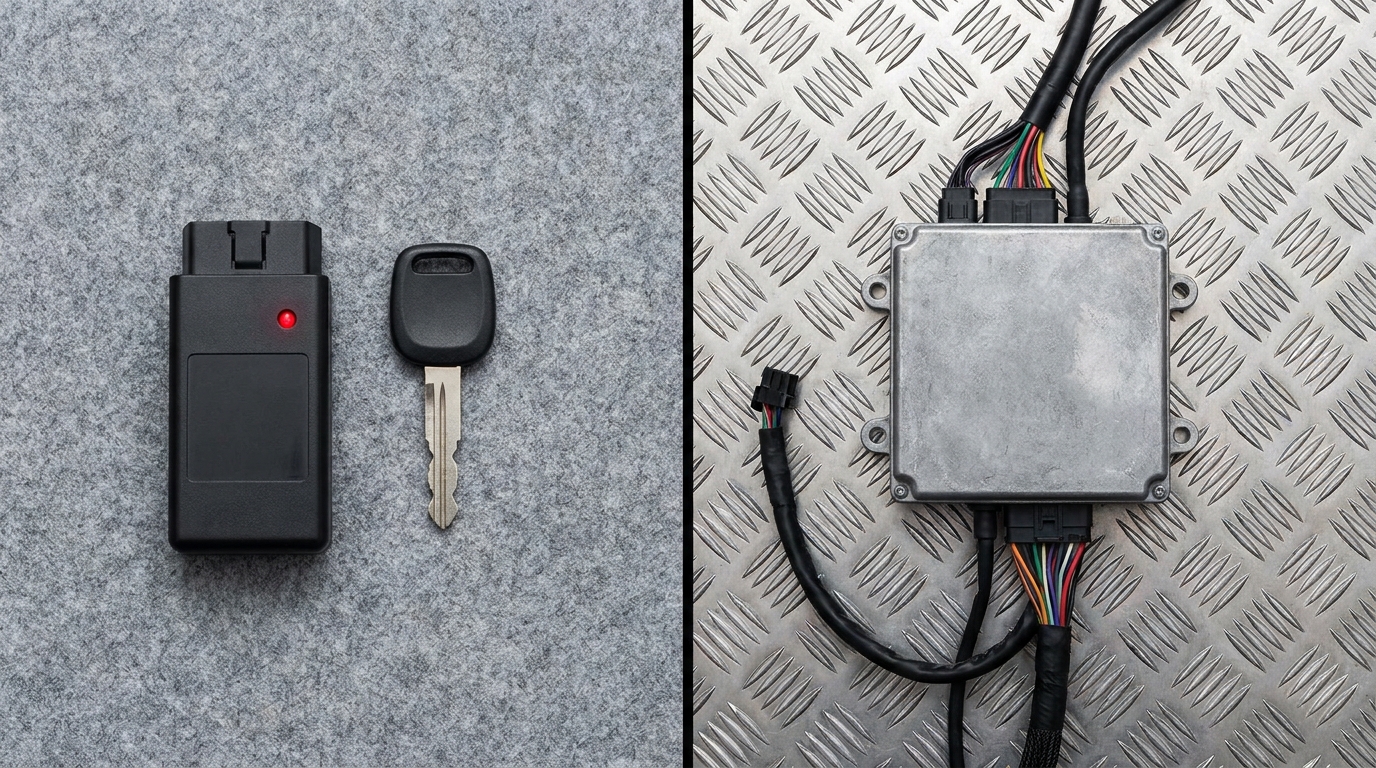
It is crucial to understand the initial appeal of an OBD2 (On-Board Diagnostics) tracker. In the world of light-duty pickup trucks (like Ford F-150s) and sprinter vans, OBD2 trackers are fantastic. They plug directly into the universal 16-pin port located just beneath the steering wheel, instantly drawing power and reading basic vehicle telemetry. The installation takes less than five seconds.
However, when evaluating an obd2 vs hardwired tracker for heavy construction machinery, the OBD2 approach fails completely for several critical, technical reasons:
-
Incompatible Data Interfaces: Heavy equipment typically does not utilize the standard 16-pin OBD2 passenger port. Construction machinery operates on heavy-duty CAN bus protocols (such as the J1939 9-pin connector). A standard OBD2 tracker physically cannot plug into a loader or bulldozer without sketchy, aftermarket adapter cables.
-
Zero Environmental Protection: Consumer OBD2 trackers have absolutely no IP (Ingress Protection) ratings. Construction cabs are completely exposed to dirt, moisture, high humidity, and open air. A non-weatherproof OBD2 tracker will rapidly corrode and short-circuit within months of deployment.
-
Extreme Vulnerability to Tampering: Because OBD2 trackers are simply plugged into a highly visible port near the operator’s knees, they are incredibly easy to remove. If a rogue operator wants to hide their location or mask unauthorized off-hours usage, they simply pull the device out. If a thief steals the equipment, the tracker is located and discarded onto the dirt within seconds.
-
Vibration Destruction: Heavy equipment generates massive vibrations. Consumer OBD2 trackers lack the reinforced internal soldering, potting, and shock-resistant casings necessary to survive continuous impact.
The Heavy-Duty Standard: 3-Wire Hardwired Telematics
For powered heavy machinery, the only acceptable procurement choice is a dedicated hardwired telematics device heavy equipment configuration. These units are explicitly engineered to survive the most brutal conditions on earth while delivering continuous, uncorrupted operational data.
A professional installation utilizes a simple but highly effective 3-wire connection to the machine’s electrical harness:
-
Constant Power (Battery): This connection ensures the GPS unit can transmit location data and geofence alerts even when the machine is turned off and parked over a long holiday weekend.
-
Chassis Ground: This wire safely completes the electrical circuit.
-
Ignition Sense: This is the most critical wire for heavy equipment. It detects exactly when the key is turned and the engine fires, allowing the telematics software to precisely track true engine operating hours versus stationary idle time.
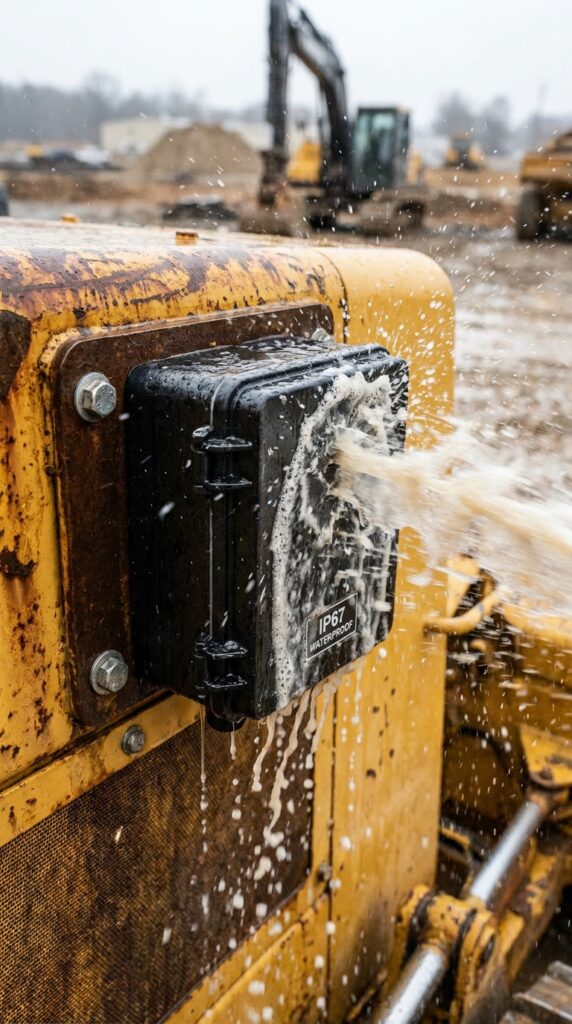
Procurement teams must demand specific environmental ratings for these hardwired units. A proper weatherproof gps excavator unit must carry a minimum IP67 or IP68 rating. An IP68 housing guarantees the device is 100% protected against fine dust ingress and can withstand continuous submersion in water or direct, close-range blasts from a pressure washer. Additionally, these heavy-duty trackers feature internal backup batteries. If a thief attempts to bypass the system by severing the main battery cables of the excavator, the GPS unit instantly switches to its internal battery and fires off a critical sabotage alert to the fleet manager.
Furthermore, 3-wire hardwired units allow for deep, covert installations. A certified technician can bury the tracker far behind the dashboard console or under heavy steel cowlings. This makes it virtually impossible for thieves to identify, access, and disable the security unit quickly.
Protecting the Unpowered: The Battery Powered Asset Tracker
While 3-wire hardwired trackers secure your powered yellow iron, a modern job site is filled with high-value, unpowered assets. Towable light towers, diesel generators, flatbed trailers, and large skip bins are frequent targets for theft, yet they lack the continuous 12-volt or 24-volt power source required to run a hardwired tracker.
This is where the rugged battery powered asset tracker becomes an indispensable procurement category.
These specialized IoT devices operate entirely independently of any external electrical system. They utilize high-capacity, industrial-grade lithium batteries that can last anywhere from three to ten years, depending heavily on the reporting frequency.
To maximize battery life while ensuring tight security, these rugged trackers utilize “adaptive tracking” technology. When the asset is parked, the tracker drops into a deep sleep mode, waking up perhaps once a day to transmit a health ping. However, they are equipped with highly sensitive internal accelerometers. The moment a thief hitches your light tower to their truck and begins driving, the accelerometer detects the physical movement, wakes the tracker up, and immediately shifts it into active recovery mode. It will begin pinging its GPS coordinates every few minutes to assist law enforcement in a rapid recovery.
Just like their hardwired counterparts, battery-powered trackers deployed on construction sites must be IP68 rated to withstand the elements and feature IK07 or higher impact resistance ratings. They are designed for simple “slap and track” deployments—bolted, riveted, or magnetically attached directly to the steel frame of the asset where they silently stand guard for years.
Final Procurement Verdict
When drafting your heavy machinery hardware requirements, do not compromise on rugged durability to save a fraction of your budget upfront. The staggering cost of replacing a single stolen skid steer, combined with the lost productivity, far exceeds the premium paid for industrial-grade IoT hardware.
Avoid consumer-level OBD2 plug-in trackers entirely. Instead, explicitly mandate IP68-rated, 3-wire hardwired trackers for all powered heavy machinery to guarantee accurate engine hours and impenetrable security. For your unpowered trailers and attachments, deploy adaptive, long-life battery-powered trackers. By standardizing on ruggedized, construction-specific hardware, you will permanently eliminate job site blind spots, slash your maintenance downtime, and fully secure your operational assets.
Technical Disclaimer: The information provided in this guide is for educational, procurement, and strategic planning purposes. Hardware selection should always comply with Original Equipment Manufacturer (OEM) guidelines and the specific electrical schematics of your machinery. Always utilize certified heavy-duty mechanics or certified telematics installers for the installation of hardwired IoT devices on construction equipment.